
Auto-Zoom Screen Recorder for Mac: A Practical Guide
When automatic zoom helps a Mac screen recording, how to keep it from becoming camera churn, and when setting the keyframes yourself gives a clearer result.
Quick answer
Use auto-zoom when a Mac recording will be watched smaller than it was captured and a click, field, or state change would otherwise be unreadable. ScreenBuddy records the screen, a window, or a region on macOS, reads the positions you actually clicked, and turns them into zoom keyframes you can move, retime, or delete. The automatic pass is a first draft rather than a finished edit, so the useful question is how much of it you can revise afterward.
Best for
- Launch clips and feature announcements watched at feed size
- Tutorials where a small control has to stay legible for a few seconds
- Anyone who wants an automatic first pass with every keyframe still editable
Not the best fit for
- Recordings where the whole interface must stay visible continuously
- Cursor-heavy workflows where frequent zooms would read as camera churn
- Browser-only, mobile, Linux, or hosted-collaboration workflows
The problem auto-zoom actually solves
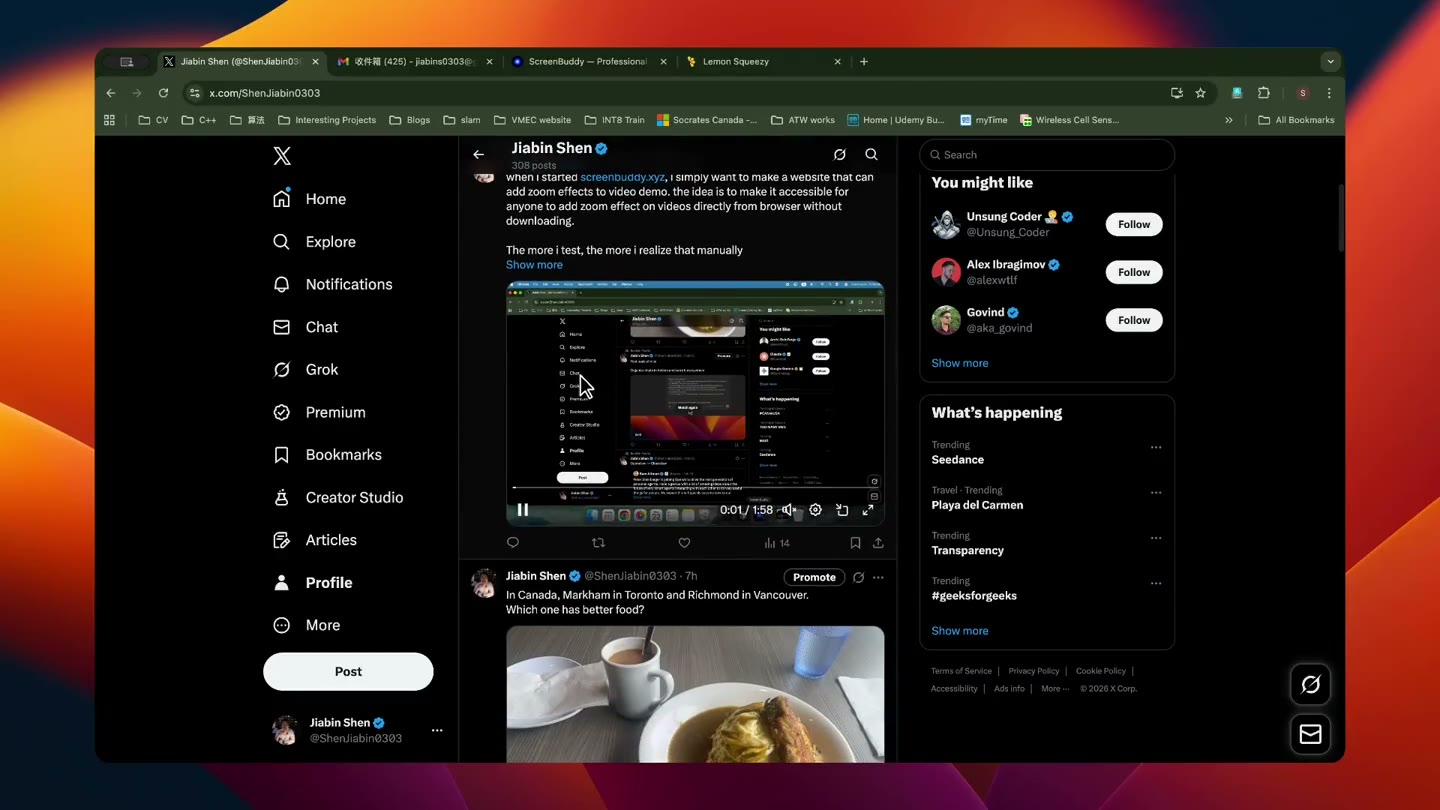
A Mac screen is captured at a size almost nobody watches it at. A display recorded full-screen and then played inside a landing-page card, a chat preview, or a phone-sized feed loses most of its detail on the way. The interface is still there; it is simply too small to read. Auto-zoom answers that gap by enlarging the part of the frame carrying the explanation for as long as the explanation needs, then returning. Everything else about the recording stays as captured.
Zoom generated from clicks, not from motion heuristics
ScreenBuddy records where you clicked during capture and generates zoom keyframes from those positions when the recording loads. That distinction matters. A click is an explicit signal of intent, while cursor movement is mostly noise: hunting for a menu, drifting while you talk, overshooting a target and coming back. Generating from clicks means the automatic pass tends to land on the moments you meant to emphasize rather than wherever the pointer happened to travel.
Every keyframe stays editable, which is the part that matters
An automatic pass you cannot revise is worse than none, because you inherit its mistakes. Each generated keyframe can be moved earlier or later, held longer, set to a different magnification between 1.25x and 5x, or deleted where the pass guessed wrong. You can also add zoom points by hand anywhere the recording needs one and no click happened to occur.
- Retime a zoom that arrives after the action it was meant to introduce.
- Hold a zoom through the pause where you explain what just happened.
- Delete emphasis on a click that turned out to be navigation, not content.
- Add a manual zoom on something that changed without being clicked.
Zoom is one of three ways to direct attention
Zoom enlarges, which means it also crops. When the surrounding interface is part of the explanation — where a panel sits relative to a sidebar, what else changed when you saved — cropping it away costs more than the magnification gains. Spotlight dims everything except the control you are naming, so context stays visible at full size. Lightbox pushes the whole interface back so one element reads first. Choosing between them is usually a question of whether the viewer needs to see where something is, or only what it says.
Record so the automatic pass has something to work with
The quality of the generated zoom depends almost entirely on the capture. Move the cursor deliberately and pause briefly before an important click, so the zoom has a beat to settle before the action happens. Avoid circling a target while you decide. Enlarge the application window before recording rather than relying on magnification to rescue a small one. Close notifications, and look at what is on screen before you press record, because a recording captures everything visible, including a customer name in a sidebar or a token in a terminal.
Review at the size people will actually watch
Preview the edit at its destination size, not at editor size. A zoom that feels generous on a large display can still be unreadable in a feed, and one that feels aggressive in the editor is often exactly right on a phone. Three failures are worth hunting for specifically: motion that starts before the viewer has located the element, a return that happens while you are still talking about the thing, and consecutive zooms with no flat frame between them, which reads as drift rather than emphasis.
What the cursor is doing while the frame moves
Magnification makes cursor problems visible that were invisible at full size. ScreenBuddy renders the real macOS cursor artwork extracted at runtime rather than a generic substitute, so a resize handle still looks like a resize handle when the frame pushes in. The pointer can be enlarged and its path smoothed, and click effects are anchored to the cursor tip, so the indicator lands where you actually clicked instead of drifting once the frame scales.
Where the file goes afterward
Recording and editing stay on the device; internet access is needed for license activation and update checks rather than for the edit itself. Export is a local MP4 or GIF, so there is no upload step, no hosted link, and no viewer analytics — a real limitation if what you wanted was a shareable URL with comment threads. Record, edit, and preview free. A one-time license is required to save or export.
Platform boundaries, stated plainly
ScreenBuddy runs on macOS 12 Monterey or later, on both Apple Silicon and Intel Macs, and on 64-bit Windows 10 or later. The recording and attention-effect workflow described here is the same on both platforms, and so is generating captions from audio: the bundled speech model now ships for Apple silicon, Intel Macs, and Windows alike.
How to judge it on your own footage
Take a walkthrough you have already published and rebuild it once. Import the recording, let the automatic pass run, then count how many of its keyframes you keep unchanged, how many you retime, and how many you delete. That ratio tells you more about whether the automation suits your material than any feature list, and it costs one recording to find out.
Frequently asked questions
Does ScreenBuddy zoom on every click?
No, and you would not want it to. It generates a first pass from the click positions recorded during capture, and every keyframe stays editable — move it, retime it, hold it longer, change magnification between 1.25x and 5x, or delete it. Navigation clicks that carry no explanation are usually the first ones worth removing.
Which Macs are supported?
macOS 12 Monterey or later, on both Apple Silicon and Intel Macs. The recording and editing workflow is identical on 64-bit Windows 10 or later, automatic caption generation included — the bundled speech model ships for Apple silicon, Intel, and Windows.
Can I add a zoom where I did not click?
Yes. Zoom points can be added manually anywhere on the timeline. That is how you emphasize something that changed without being clicked, such as a progress bar completing, a chart redrawing, or a validation message appearing after a form submits.
Is auto-zoom available on Windows?
Yes. The capture and attention-effect workflow, including click-generated zoom, is the same on macOS and on 64-bit Windows 10 or later. A separate guide covers the Windows workflow specifically.
How is this different from a general-purpose video editor?
A general-purpose editor can produce the same result, but you build each zoom by hand as a keyframed scale-and-position animation, and nothing in the timeline knows where you clicked. The difference is not what is achievable — it is how much of the first pass you construct yourself before you start revising.
Does zooming reduce the quality of the recording?
Zooming crops into the captured pixels, so the more you magnify, the more you enlarge a smaller source area. Recording at the display’s native resolution rather than a scaled-down one gives the zoom more detail to work with, which is why enlarging the application window before recording usually beats relying on magnification afterward.
Can I export without buying a license?
No. Record, edit, and preview free. A one-time license is required to save or export.
Turn your recording into a clearer demo.
Record your screen on Mac or Windows, trim pauses, guide attention with zoom and annotations, and add captions in ScreenBuddy. Build a simple walkthrough or combine scenes into a polished product demo. Record, edit, and preview free. A one-time license is required to save or export. Media processing stays on your device, while activation and update checks require internet access.